















From fragmented devices to an integrated IT system: What are businesses missing?
Have you invested heavily but your IT systems are still fragmented? Discover the causes and how to build a stable, secure, and scalable IT infrastructure.
IT Infrastructure in Digital Transformation: How to Invest Without “Patching Issues” Later
Digital transformation is becoming a top priority for many businesses, especially as data and systems play an increasingly critical role in daily operations. However, many organizations still struggle to build an IT infrastructure that is both stable and flexible.
Despite multiple upgrades, systems often fail to meet expectations. Networks remain unstable, data is scattered, and challenges around data security and access control are still not fully addressed.
👉 The issue is not necessarily the technology itself, but the approach.
1. When IT infrastructure grows in a “patchwork” way
In day-to-day operations, the need for system upgrades is completely normal. However, when each issue is handled separately, the overall system gradually becomes fragmented.
In practice, it often looks like this:
- Lack of storage → add servers or NAS
- Slow network → upgrade WiFi
- Security concerns → add more software
These actions may solve immediate problems, but over time they lead to:
- Scattered data, difficult to manage
- Inconsistent data storage
- Disconnected security layers
- Limited scalability as the business grows
👉 The larger the system becomes, the harder it is to control.
2. IT infrastructure should be built as a unified system
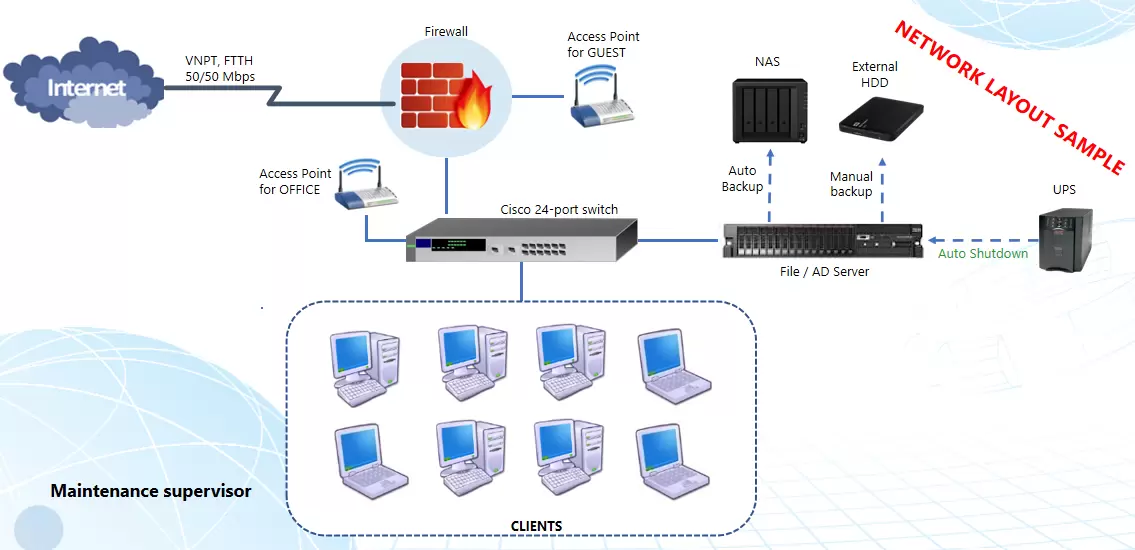
To effectively support digital transformation, IT infrastructure should not be a collection of standalone components, but a well-designed, integrated system.
A structured system typically includes:
- Stable & secure network
Firewall, core switches, and enterprise WiFi ensure continuous connectivity. - Centralized data storage
Data is stored on servers, making it easier to manage and share. - System management (Domain)
User access and permissions are clearly controlled. - Automated data backup
Regular backups to NAS ensure recoverability. - Data security & loss prevention
Control over USB, email, cloud usage to minimize data leakage. - System monitoring
Track access, edits, and deletions to improve transparency.
These components are not meant to function independently—they must be designed to work together as a unified system.
👉 This is the foundation for stable operations and scalable growth.
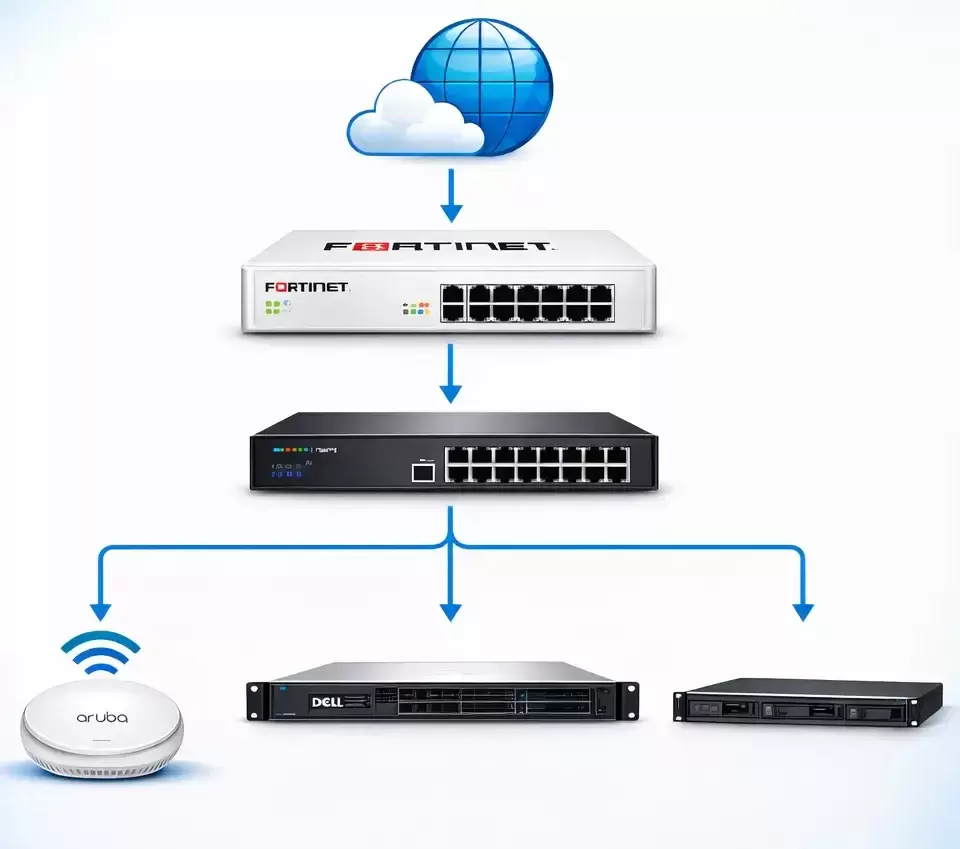
Integrated IT infrastructure model in an enterprise
3. From system setup to operations: NSV’s approach
In reality, businesses still need to invest in hardware. However, hardware is only one part of the overall solution.
NSV approaches IT infrastructure by combining products, solutions, and services to ensure long-term effectiveness.
Specifically:
- Assessing the current state
Evaluating infrastructure, data, and existing operations. - Designing tailored solutions
Customized based on business size, needs, and budget—no one-size-fits-all approach. - Implementing an integrated system
Ensuring all components work seamlessly together. - Ongoing maintenance & optimization
Regular checks, system monitoring, and continuous improvements.
👉 As a result, businesses not only have IT infrastructure but can also operate and leverage it effectively over time.
Conclusion
In digital transformation, IT infrastructure is not just a foundation—it is a key factor that determines operational efficiency.
If your system is:
- Frequently upgraded but still unstable
- Difficult to manage due to scattered data
- Raising ongoing security concerns
👉 It may be time to rethink your investment approach.
Instead of fragmented implementation, a holistic approach—from data storage and data security to system management—will help businesses operate more efficiently and sustainably.
👉 NSV provides IT infrastructure solutions tailored to real business needs, combining hardware, solutions, and long-term operational services.
Related posts
How to Shorten Product Development Time: 5 Critical Factors Companies Often Overlook
Comparing Enterprise Information Security Solutions: Which One Is the Right Choice?
Understanding Cyber Attacks: How They Happen and How Businesses Can Protect Themselves

NSV: Partnering to Protect Businesses Against Ransomware in 2025