
















The workflows shown in Figure 3 are all connected to the electric drive. The 3DEXPERIENCE® platform facilitates analysis and design evaluation workflows related to the e-drive by seamlessly integrating various workflows to assess different design specifications, such as performance evaluation for electromagnetics, structural integrity, and vibration design. In addition to the electric drive workflows, the implementation of a parametric CATIA geometry model allows users to analyze a wide range of design options, leading to an optimized design.
Applying Virtual Twin Technology for Faster, More Cost-Effective, and More Optimized Transportation Vehicle Design
Vehicle design is a challenging, time-consuming, and costly process. Increasing customer expectations are forcing automotive OEMs to develop vehicles with higher performance while still reducing development costs and time to market.
Table of Contents
Vehicle design is a challenging, time-consuming, and costly process. Rising customer expectations are forcing automotive OEMs to design vehicles with higher performance while simultaneously reducing development costs and vehicle development time.
In this paper, we focus on Virtual Twin technology and how it can successfully address vehicle design challenges, particularly thermal-related issues. Virtual Twin technology is understood as a virtual representation of a physical object, enabling engineers and analysts to evaluate design prototypes through virtual simulations. This approach significantly reduces time and cost compared to development processes based on physical testing.
In terms of vehicle thermal design, this refers to the process of defining thermal specifications for the vehicle—such as temperature limits for vehicle components—and ensuring that these thermal targets are achieved.
For automotive OEMs, failing to meet thermal design targets results in immediate consequences, including component failures and increased warranty costs. In 2020 in the United States, there were 900 separate vehicle recalls related to safety issues, affecting 55 million vehicles, with temperature being the most common cause of safety-related problems. More critically, thermal failures directly impact passenger safety.
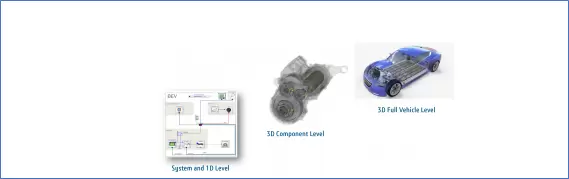
In Figure 2, we can see the different levels of the virtual vehicle model, with each level representing specific operational aspects of the vehicle at a given development stage. System-level and 1D models are applied during the early design phase, where the basic vehicle design and layout, as well as functional specifications, are evaluated. At later stages, we develop virtual models that represent vehicle components at the 3D level with accurate geometric representations. These virtual models are used during the build and prototyping phases.
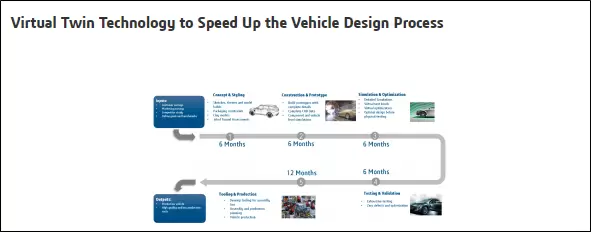
By applying this Virtual Twin modeling approach, a vehicle development process that typically takes three years can be reduced to less than 20 months.
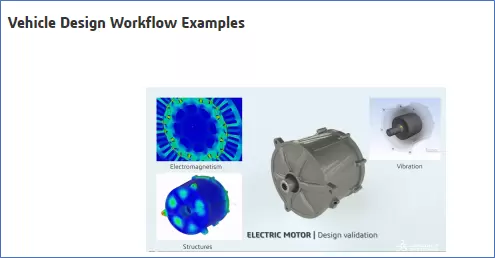
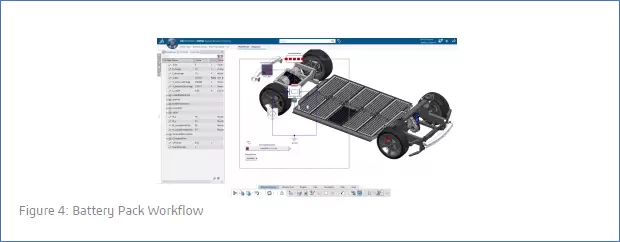
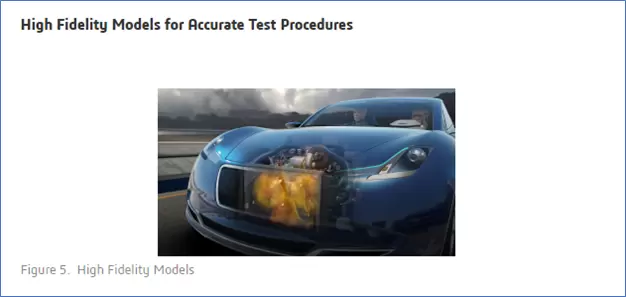
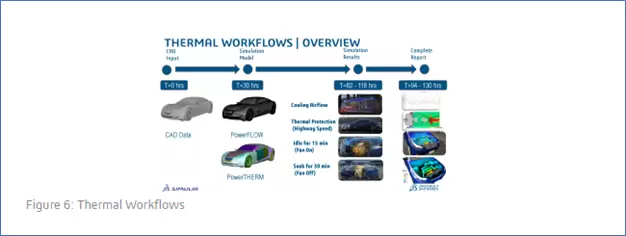
Figure 6 shows validated thermal workflows that simulate the standard testing procedures used by automotive OEMs for product development. With automated tools, the total turnaround time from CAD to final report is less than six days for all workflows, resulting in significant savings in both cycle time and cost for the vehicle design process.
Cooling airflow simulation enables design engineers to optimize the cooling system layout and evaluate trade-offs with vehicle aerodynamic drag and interior noise. The Thermal Protection workflow identifies components that exceed design temperature limits, resolves thermal issues, and optimizes shielding. The Soak and Parked (Key-Off/Soak) workflow simulates vehicle testing under transient conditions such as key-off/soak events and accurately identifies temperature rise peaks.
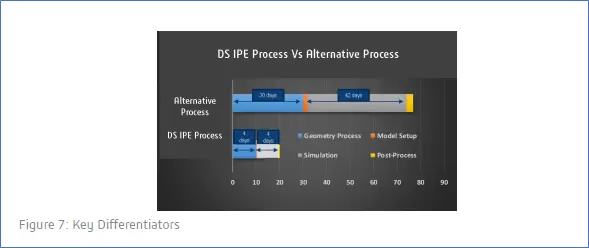
In Figure 7, we compare the turnaround time of the Dassault Systèmes workflow with that of an alternative competitor workflow. We observe that turnaround times for both geometry processing and simulation are significantly faster with the Dassault Systèmes workflow. The primary enabling factor is the use of accurate vehicle geometry without simplification, as the PowerFLOW solver is highly capable of handling complex geometries. In contrast, alternative workflows require simplified or approximate geometry; otherwise, the simulations risk solution divergence. In terms of simulation completion time, PowerFLOW runs significantly faster for transient simulations compared to the alternative workflow.
We find that the thermal workflows provided by Dassault Systèmes enable faster turnaround and lower costs by requiring fewer physical prototypes in the vehicle design process. However, a key requirement for simulation-based workflows is the accuracy of the simulation tools. In the following section, we present several validation results for PowerFLOW.
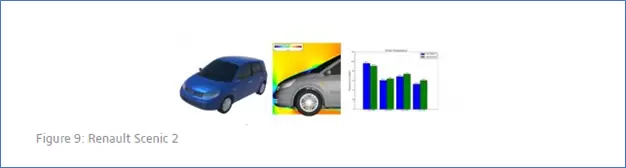
In Figure 9, we compare thermocouple measurements for the Renault Scenic 2 vehicle with simulation results reported in [3]. We observe good correlation, as shown in the bar chart on the right. On the left, we present an image of the test vehicle, and in the center, the velocity field in the y-plane.
Dassault Systèmes provides Virtual Twin technology that enables a complete digital evaluation of a vehicle from concept to production. With proven accuracy, SIMULIA simulation tools and workflows allow for reduced costs and shorter turnaround times in the vehicle development process.
Related posts
AI in R&D: What Should Companies Prepare for Effective Implementation?
What should companies prepare before implementing AI in R&D? Explore five key areas — data...
Can AI Replace Design Engineers? The Future of AI in Engineering
Can AI replace design engineers? Discover how AI is changing engineering, the role of AURA...
When Does Your Business Need PLM? 7 Signs to Look For
When does your business need PLM? Discover 7 key signs, from version control issues and di...
How to Shorten Product Development Time: 5 Critical Factors Companies Often Overlook
Want to shorten product development time but don't know where to begin? Discover five crit...
Modern Product Development: Why Many Manufacturers Still Face Product Launch Delays
In today’s manufacturing environment, product development is no longer an isolated task ha...